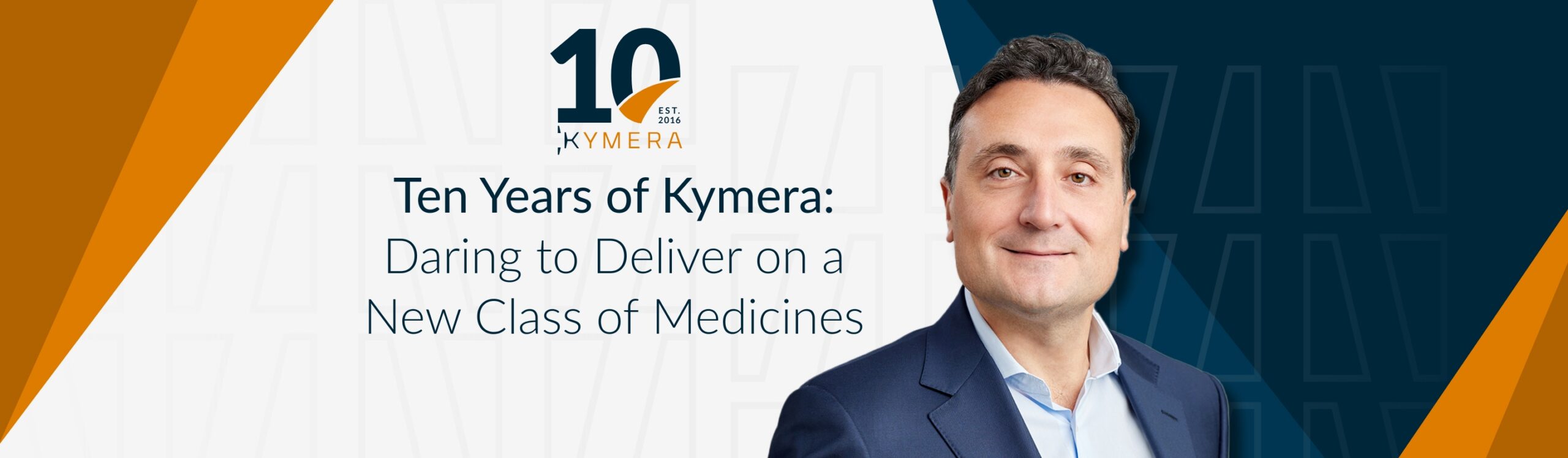


Ten Years of Kymera: Daring to Deliver on a New Class of Medicines
This blog post is part of the New Paradigms LinkedIn newsletter.
I have always believed that the most meaningful progress happens when you are willing to be outside your comfort zone. It is a belief I held before Kymera existed, and it is one that has defined every chapter of what we have built together over the past decade.
Ten years ago, in May of 2016, I and others at Atlas Venture founded Kymera with an audacious premise: that targeted protein degradation (TPD), a modality still in its scientific adolescence, could unlock a new era of breakthrough medicines by going after disease-causing proteins that had been deemed undruggable for decades. We were not the only believers in the science, but we were committed to being among the most deliberate and disciplined in translating that belief into real medicines for millions of patients around the world.
Today, as I sit down to mark this milestone, I am struck less by how much has changed and more by how unwavering our mission has remained. The questions have evolved. The team has grown. The science has deepened in ways that still surprise and humble me. But the north star, to build medicines that matter for patients who have been left behind by existing therapies, has never wavered.
The First Five Years: From Idea to Clinical Entry
I described Kymera’s first five years, at the time of our 2021 anniversary, as a journey from idea generation to clinical entry. That framing still feels right. In those early years, we built a platform and capabilities from the ground up, from a set of slides. We invested in building the best hit finding platform in industry, in cryo-EM, structural biology, chemistry, PK/PD modeling, and translational biology when many told us it was too early and too expensive for a young biotech. We made those investments deliberately, because we understood that to go after the hardest targets in biology, you cannot borrow someone else’s toolkit.
In 2021, we brought KT-474, our oral IRAK4 degrader, into a first-in-human study, the first heterobifunctional small molecule protein degrader outside of oncology to enter clinical development. It was, at the time, the clearest proof that our approach worked: that you could take a poorly drugged scaffolding protein, design a degrader with great potency and selectivity, and demonstrate in patients that TPD could deliver a level of pathway blockade comparable to complex injectable biologics. The subsequent publication of the KT-474 Phase 1 data in Nature Medicine, the first published clinical trial of a heterobifunctional degrader, cemented that proof not just for Kymera, but for the entire field.
The Second Five Years: Turning Proof into Pipeline
If the first five years were about building capabilities to prove that TPD could work in humans, the second five years have been about proving that it can work repeatedly, reliably, and in diseases that represent enormous unmet need. Importantly it proved that when you apply TPD to the right target, the right pathway, the right disease you can deliver something that in the history of drug development has rarely if ever been shown: oral medicines with biologics-like profiles.
The story of STAT6 is a microcosm of our last five years. STAT6 is the obligate transcription factor of IL-4/IL-13 signaling, the same pathway targeted by dupilumab, today a $20+ billion injectable biologic. The pathway has strong human genetic validation; gain-of-function mutations cause severe, early onset allergic diseases. And yet, for 10 to15 years before we began our program, STAT6 was considered undruggable. Traditional small molecule inhibitors could not crack it.
We believed we could. And we were right.
In January 2024, we unveiled KT-621, the first STAT6-targeted agent to enter clinical development, at our Immunology R&D Day. In October 2024, we announced first-in-human dosing. In June 2025, we reported positive Phase 1 healthy volunteer data showing >90% STAT6 degradation in blood and skin at once-daily oral doses as low as 6.25 mg, with Th2 biomarker effects comparable to or numerically superior to dupilumab — and a pristine safety profile.
And then, in December 2025, we completed the most important translation of all: 22 patients with moderate to severe atopic dermatitis in our BroADen Phase 1b study. KT-621 demonstrated deep STAT6 degradation in blood (98%) and skin (94%). It showed profound reductions in disease-relevant Type 2 biomarkers. Importantly, it produced robust clinical improvements across skin, itch, sleep, and quality of life measures comparable to or numerically exceeding dupilumab at week four. And in patients with comorbid asthma, it achieved a >60% reduction in FeNO and a robust effect on ACQ-5 within the first four weeks, a result not previously observed with any agent in this pathway.
An oral drug with biologics-like activity, we have built it. And many more will come!
What We Have Learned: Three Enduring Principles
Ten years is long enough to know what you believe with conviction. As I reflect on this decade, three principles stand out as the ones that have most defined Kymera’s trajectory.
Target selection is everything.
We have always said this, and the last decade has proved it. We do not degrade proteins simply because we can. We pursue a strict selection strategy because we’re working to solve critical challenges in healthcare: undrugged or inadequately drugged targets, with strong human genetics and clinical pathway validation, where TPD is the only or best available modality. IRAK4, STAT6, IRF5, these are highly intentional choices. They are the result of years of rigorous biological interrogation. Our almost 100% success rate in identifying ligands for difficult to drug proteins, including transcription factors, in recent years is a testament to how far our platform has come.
Culture is the enabling science.
I’ve noted before that culture it is critically important, and that perspective remains unchanged. The speed and quality of execution at Kymera is not accidental. It flows from a culture built on a sense of excellence, urgency, truth-seeking, and a willingness to challenge the status quo, not just in science, but in how we work together. For example, going from IND filing to starting a Phase 2b trial in less than one year for KT-621, or going from signing a CDK2 collaboration with Gilead to nominating a development candidate and triggering an option exercise in nine months, are not pipeline stories. It is a culture story. Our people, at every level, treat every week, every day, and every hour as consequential. Patients are counting on us and we feel that weight, and it motivates us.
Long-term thinking is the only sustainable strategy.
From day one, we decided we were building a fully integrated biopharmaceutical company, one that discovers, develops, and ultimately commercializes medicines. That long-term orientation has required patience, and it has required capital discipline. But it has also allowed us to make investments that compound over time. The capabilities we built to advance IRAK4 made STAT6 possible. The lessons from STAT6 will make IRF5 and the programs that follow even better. This is what compounding scientific capital looks like. We couldn’t have done it without the help and support of committed investors and partners along the way, that believed in the vision just as much as our next dataset.
The Pipeline That Defines the Next Decade
As we enter our second decade, we do so with the most exciting oral pipeline in the industry. KT-621 is in global Phase 2b trials in atopic dermatitis and asthma. KT-579, our first-in-class oral IRF5 degrader, has entered the clinic with the potential to be the first IRF5-targeted therapy for lupus and other rheumatic diseases where patients currently have few effective options. KT-485, our next-generation oral IRAK4 degrader, is advancing in partnership with Sanofi. And through our collaboration with Gilead, KT-200, our CDK2 molecular glue degrader, has the potential to dramatically improve quality of life of many women with cancer; validation not only of the asset but of our model of disciplined, strategic partnering.
Importantly, the next decade will be the one where Kymera will be globally commercializing a whole new generation of drugs, orals with biologics-like activity to accomplish a key goal – expanding the number of patients that have access to effective systemic therapies without needing to choose between efficacy, safety and convenience.
We continue to expect to advance at least one IND per year. That is not an aspiration; it is a standard to which we hold ourselves. The research engine that Juliet Williams, our Head of Research, and her team have built is delivering against that standard, systematically unlocking targets that have frustrated the industry for decades. More to come on that front, for now it is worth saying: the era of the undruggable is ending, and Kymera is one of the companies on the forefront of this revolution.
The People Who Make It Possible
We started with one employee, myself, in 2016. We celebrated our 100th in 2021. Today, Kymera is a company more than 250 scientists, clinicians, operators, and business leaders, people who have chosen to bring their talent and their urgency to the hardest and most important problems in medicine.
We have been recognized as one of Boston’s top workplaces for multiple consecutive years. That recognition matters to me not as a trophy, but as a signal. You cannot deliver science at this pace, at this quality, unless the people doing it feel inspired, respected, and genuinely committed to the mission. Our culture of excellence, a phrase we use deliberately, specifically and constantly at Kymera, is not a values statement on a wall. It is the set of behaviors and principles that govern how we operate every day. I am grateful to every member of this team for making it real.
Why We Do This
I keep an empty pill bottle on my desk. I have mentioned this before, and I mention it again because I think it matters. It is a reminder of the gap between what exists and what is possible. It is a reminder that more than 140 million people around the world suffer from Type 2 inflammatory diseases, and that fewer than two million of them currently receive an effective therapy. It is a reminder of the parents who write to us about their children with severe eczema who cry every time they receive an injection and who are following every KT-621 milestone with hope.
We are building medicines for them. For the patients with lupus who have run out of effective options. For the people with asthma and COPD whose comorbidities compound silently. For those who simply deserve a better first option that doesn’t compromise efficacy for convenience.
Ten years in, I am more motivated than I have ever been. Not because the work is easier, drug development is never easy, and our best and most honest moments are the ones where we acknowledge how much we still do not know. But because the evidence accumulating in our hands, from healthy volunteers to patients, from blood to skin, from biomarkers to clinical scores, is telling a coherent and extraordinary story. TPD works. The targets we chose are the right ones. The medicines we are building have a genuine chance to change lives at scale and solve for the most basic ask that all patients have: easy, simple, effective and safe medicines.
We Are Only Just Getting Started
At the five-year mark, I wrote that we were only at the beginning. At the ten-year mark, I believe it even more deeply. We have built the platform, the pipeline, the team, and the culture. We have validated TPD in humans, we have started to demonstrate that an oral pill can match the efficacy of a blockbuster biologic. We have earned the right to say that the next decade belongs to Kymera, the era in which millions of patients around the world will have a bottle of pills in their medicine cabinet with “Kymera” on it and importantly they will lead better lives because of it.
To our team: thank you for your relentless commitment, your scientific courage, and your shared sense of what matters.
To our partners, collaborators, and investors: thank you for believing in the mission and in the science.
To our patients and the families who put their hope in us: we see you, we feel the weight of your trust, and we will not let up.
Ten years down. The best is still ahead.
Nello Mainolfi
Founder, President & CEO
Kymera Therapeutics